📍 Dumfries & Galloway, Scotland | ☎ 07507 123784 | ✉ info@royalgleam.co.uk

Renovation work can transform a property, but it rarely leaves the space ready to use. Fine dust settles on ledges, floors, doors and fittings; protective materials and packaging remain; and small marks can become visible only after the builders have left.
An after-builders clean is the detailed final clean carried out once building, decorating or refurbishment work is complete and the property is safe to enter. It bridges the gap between “the work is finished” and a home, holiday let, rental property or workplace being clean, presentable and ready for handover.
Royal Gleam provides after-builders cleaning in Dumfries, Thornhill and nearby communities. Every job is assessed individually because a lightly decorated room and a full-property renovation require very different scopes.
What is after-builders cleaning?
After-builders cleaning—also called post-renovation or post-construction cleaning—is more detailed than an ordinary domestic clean. Its purpose is to remove accessible dust, general building mess and cleaning-safe residue after the trades have finished.
It is not a substitute for builders completing their contracted work, making the site safe or correcting defective workmanship. Before cleaners arrive, exposed wiring, unsafe flooring, sharp objects, unstable materials and other hazards must be dealt with by the responsible contractor.
Why construction dust needs careful handling
Fine dust can travel well beyond the room where work took place and may resettle after the first pass. That is why a thorough clean normally works from higher surfaces downwards and may involve repeated vacuuming and wiping.
The Health and Safety Executive warns that construction dust is not merely a nuisance and can present a real risk to the lungs. Dust-generating work should therefore be complete before the final clean begins, with the site made safe and suitable controls used by the responsible trades while work is underway. Read the HSE guidance on construction dust.
After-builders cleaning checklist
The exact checklist should be agreed for the property, but a detailed clean may cover the following accessible areas.
Throughout the property
- Remove loose dust from accessible horizontal surfaces
- Vacuum suitable floors, edges and corners using appropriate equipment
- Mop hard floors where the finish allows it
- Clean skirting boards, doors, frames and reachable ledges
- Wipe suitable switches, socket surrounds and fixtures without interfering with electrical components
- Clean accessible, emptied cupboards and shelving when included in the quotation
- Polish mirrors and clean internal glass
- Complete a final presentation check before handover
Kitchens and utility areas
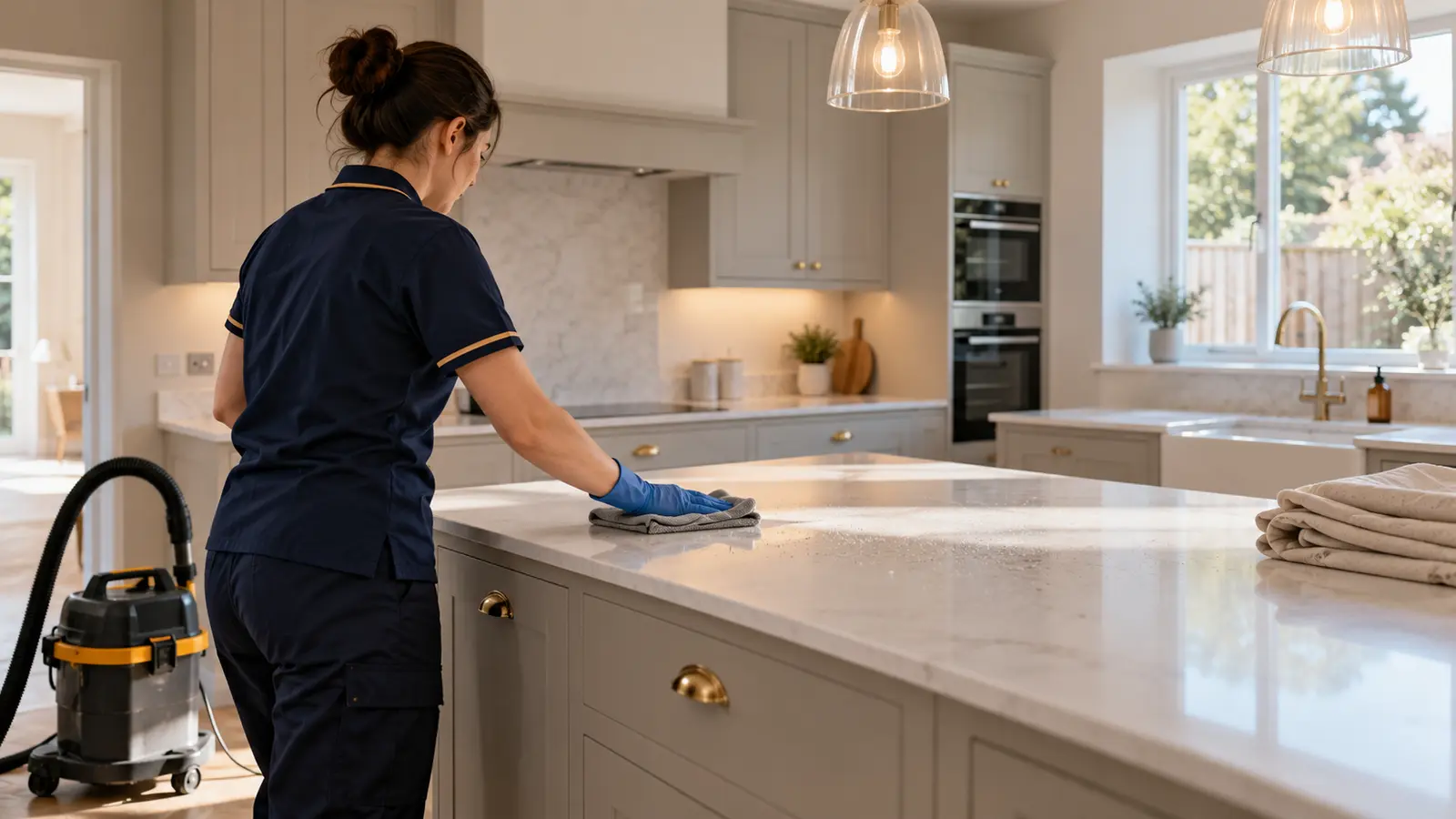
- Clean worktops, sinks and suitable splashbacks
- Wipe cupboard fronts, handles and agreed internal storage
- Remove loose dust from suitable appliance exteriors
- Check plinths, corners and edges where fine dust gathers
- Vacuum and clean the floor using a method suitable for its finish
Bathrooms and washrooms
- Clean toilets, basins, baths and showers
- Wipe suitable tiles, screens and fittings
- Polish mirrors and accessible chrome
- Remove loose dust from surfaces, ledges and floors
- Check that protective film and labels have been removed where safe and agreed
Living areas, bedrooms and hallways
- Dust reachable ledges, radiators and fitted storage
- Clean doors, frames, skirting boards and suitable woodwork
- Vacuum carpets or clean hard flooring as agreed
- Check stairs, bannisters, corners and thresholds
- Remove accessible dust from empty built-in furniture
Residue, paint and protective materials
Paint spots, plaster, grout, silicone, adhesive and protective film sometimes need specialist treatment. Aggressive scraping or unsuitable chemicals can permanently damage glass, tiles, worktops, flooring and newly painted surfaces.
These items should be identified before the quotation. Removal is assessed rather than automatically guaranteed, and a small test area may be appropriate on delicate or unfamiliar finishes. Heavy deposits caused by incomplete trade work may need to be corrected by the contractor who created them.
How to prepare before the cleaners arrive
- Finish dusty work. Drilling, sanding, cutting, plastering and similar tasks should be complete.
- Allow finishes to cure. Newly painted, sealed, grouted or treated surfaces should be ready for safe cleaning according to the installer or manufacturer.
- Remove tools and materials. Clear floors and surfaces so the cleaning team can work safely and efficiently.
- Ask trades to remove their waste. Builders should complete any waste-removal responsibilities included in their contract.
- Identify delicate surfaces. Tell Royal Gleam about natural stone, untreated timber, specialist coatings, newly fitted flooring and other sensitive materials.
- Provide safe utilities and access. Suitable electricity, water, parking and entry arrangements may be needed.
- Explain the deadline. Confirm whether the property is being prepared for occupants, guests, tenants, photographs, inspection or handover.
- Send clear photographs. Images of every affected room help establish whether a site visit is needed and reduce surprises on the day.
Waste and skip coordination
Trade waste should normally be removed by the contractor when that forms part of the building agreement. Where extra disposal support is needed, Royal Gleam can discuss coordinating a suitable registered waste carrier or skip provider as a separately agreed service.
Waste will not be transported unless the person or business carrying it has the authorisation required for that activity. SEPA explains the registration requirements for transporting waste produced by another person and provides a public register for checking authorisations. See SEPA’s guidance on transporting waste.
Asbestos, unknown chemicals, gas cylinders, sharps, contaminated materials and other hazardous or controlled waste are outside ordinary cleaning. These must be handled by an appropriately authorised specialist.
Optional specialist services
Some properties need work outside a standard cleaning scope. Royal Gleam can arrange the following through suitable subcontractors when requested:
- Carpet cleaning or extraction: for fitted carpets that require specialist machinery after renovation work.
- External window cleaning: for exterior glass, upper-level windows or work needing specialist access equipment.
Subcontracted services are identified clearly and quoted separately. Royal Gleam does not present subcontracted specialist work as being completed directly by its own cleaning team.
What is not included automatically?
An after-builders quotation covers only the tasks agreed in writing. It does not automatically include asbestos work, hazardous-waste handling, mould remediation, pest control, electrical or gas work, structural repairs, specialist high-level access, carpet extraction, external-window cleaning, skip hire or the correction of defective building work.
Minor practical issues discovered during a clean can be reported and, where appropriate, assessed separately through Royal Gleam’s property maintenance and inspection support. Regulated, structural and specialist work must be referred to a suitably qualified professional.
When should the final clean happen?
The most efficient time is after all dusty work and decorating are complete, tools and materials have been removed, finishes have cured and the property has been made safe. Cleaning too early usually means surfaces become dusty again.
A staged clean can sometimes help on a larger project, but it should not be confused with the final presentation clean. If several trades are finishing at different times, agree exactly which areas are ready and which will need another visit.
How after-builders cleaning is quoted
There is no honest fixed price that suits every renovation. Royal Gleam considers:
- Property size and number of affected rooms
- Type and extent of the work completed
- Amount and spread of dust and residue
- Flooring, worktops and other surface materials
- Access, parking and working conditions
- The required deadline and handover standard
- Whether subcontracted carpet or external-window cleaning is required
- Whether a registered waste carrier or skip provider needs coordinating
A written scope makes clear what is included, what needs specialist attention and what must be completed by the builder before cleaning begins. You can also review Royal Gleam’s wider cleaning and property-support services.
Final handover check
Before the property is occupied or photographed, walk through it in good natural and artificial light. Check floors, ledges, internal glass, doors, sanitary fittings, kitchen surfaces, cupboards included in the scope and any priority areas agreed at quotation stage. If building work resumes afterwards, expect some dust to return.
After-builders cleaning in Dumfries and Thornhill
Royal Gleam’s main service areas are Dumfries and Thornhill, with work considered in nearby communities including Penpont, Tynron, Moniaive, Closeburn, Carronbridge, Auldgirth, Keir, Durisdeer, Sanquhar, Cargenbridge, Lochfoot, Holywood, Dunscore, Torthorwald, Collin, Kingholm Quay, Glencaple, New Abbey and Beeswing. Availability depends on the location, property and scale of work. Check the Areas We Cover page for details.
Frequently asked questions
Can Royal Gleam clean while builders are still working?
A staged clean may sometimes be possible, but the final clean is most effective after drilling, sanding, cutting, plastering and decorating have finished and the site is safe.
Can Royal Gleam remove builders’ waste?
Builders should remove trade waste covered by their contract. Royal Gleam can discuss coordinating a suitable registered waste carrier or skip provider, quoted separately. Hazardous or controlled materials require an appropriate specialist.
Does after-builders cleaning include carpet cleaning?
Standard vacuuming may be included where suitable. Specialist carpet extraction can be arranged through a subcontractor and quoted separately.
Does it include external windows?
External-window cleaning can be arranged through a subcontractor. It is not automatically included in the standard cleaning scope.
Will every paint or plaster mark be removed?
No responsible cleaner should guarantee this without assessing the material and the surface beneath it. Some residue requires specialist treatment, and removal may risk damage. The safest method and reasonable result should be agreed first.
Request an after-builders cleaning quotation
Send the property location, number of affected rooms, photographs, type of building work, expected completion date and any specialist services required. Royal Gleam will review the details and provide a quotation based on the actual condition and agreed scope.